

Why Autistic Women Are Often Diagnosed Late

Why Autistic Women Are Often Diagnosed Late
For many years, autism has been misunderstood—not just by society, but even within medical and psychological spaces. And while awareness has grown, one group continues to be overlooked: women.
Many autistic women go undiagnosed until adulthood, sometimes only discovering their identity after years of confusion, burnout, or feeling “different.” But why does this happen?
Autism Was Historically Studied in Boys
Most early autism research focused on young boys, which shaped what we now recognize as “classic” autism traits such as visible social difficulties, repetitive behaviors, and communication challenges.
Because of this, the diagnostic criteria were built around how autism presents in males. Girls and women who don’t fit this mold are often missed entirely.
Girls Learn to Mask Early
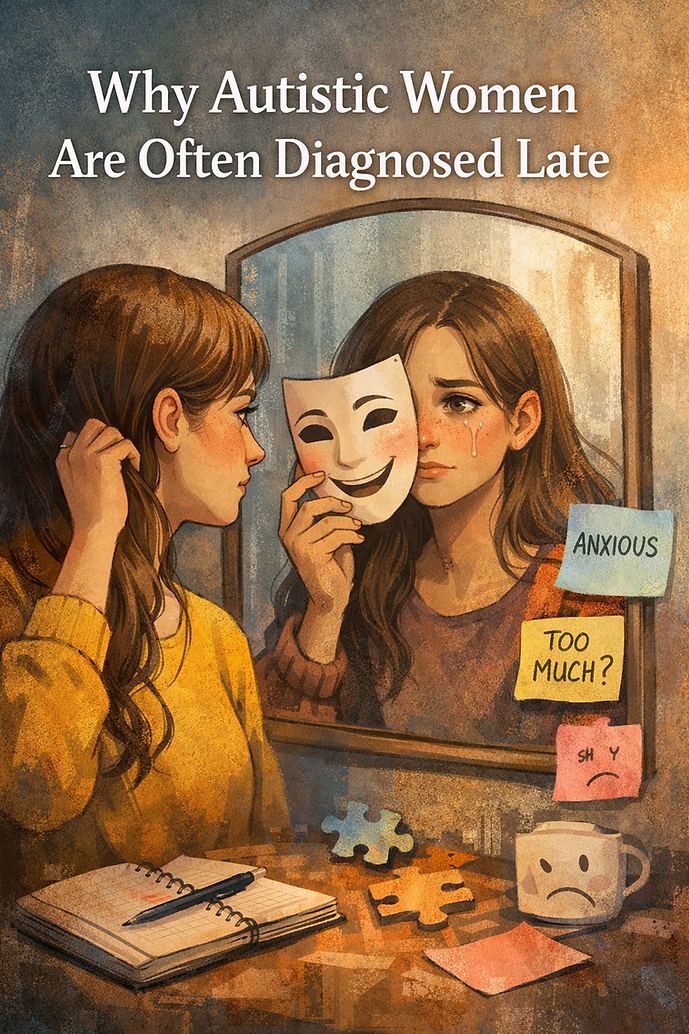
One of the biggest reasons autistic women are diagnosed late is something called masking.
Masking is when someone consciously or unconsciously hides their autistic traits to fit in socially. This might look like:
Copying how others speak or behave
Forcing eye contact
Rehearsing conversations in advance
Suppressing natural responses or stimming
From a young age, many girls are socially conditioned to “blend in,” be polite, and maintain relationships. Over time, masking can become so automatic that even the person themselves doesn’t realize they’re doing it.
While this can help them navigate social situations, it often comes at a cost leading to anxiety, exhaustion, and identity confusion.
Different Social Expectations for Women
Society tends to expect girls to be more socially aware, communicative, and emotionally expressive. When an autistic girl struggles, she may not be seen as autistic instead, she might be labeled as:
Shy
Sensitive
Anxious
“Too much” or “too quiet”
Because of these assumptions, the root cause is often overlooked.
Their Interests May Seem “Typical”
Autistic individuals often have deep, focused interests. In boys, these might be things like trains, numbers, or systems—interests that stand out.
In girls, however, these interests may align more closely with what society considers typical, such as:
Books or storytelling
Animals
Music or art
The difference isn’t the interest itself—it’s the intensity. But because the topic seems “normal,” the depth of focus is often missed.
Misdiagnosis Is Common
Before receiving an autism diagnosis, many women are diagnosed with other conditions such as:
Anxiety
Depression
ADHD
Personality disorders
While these may be valid co-occurring conditions, they can sometimes mask the underlying autism—delaying accurate understanding and support.
Is Shame Part of the Story?
Shame can absolutely play a role but it’s usually not the starting point.
Many autistic women grow up feeling different without understanding why. They may internalize this difference as something being “wrong” with them. Over time, this can lead to:
Hiding struggles
Avoiding seeking help
Feeling pressure to appear “normal”
So while shame isn’t the cause of late diagnosis, it can reinforce the cycle of masking and silence.
The Cost of Being Missed
Late diagnosis isn’t just a label delayed—it often means years of unsupported experiences.
Many women report:
Chronic burnout
Difficulty maintaining relationships
Low self-esteem
Feeling misunderstood or unseen
But receiving a diagnosis later in life can also be incredibly empowering. It can bring clarity, self-acceptance, and access to the right support systems.
Moving Forward: Awareness and Inclusion
Understanding how autism presents in women is essential—not just for professionals, but for families, educators, and communities.
We need to:
Broaden how we define autism
Listen to lived experiences
Create safe spaces where differences are understood, not judged
At Nione, we believe that every individual deserves to be seen, supported, and celebrated for who they are.
Being diagnosed late doesn’t mean you were “missed”it means the system is still catching up.
And as awareness grows, so does the opportunity to create a world where no one has to hide who they are to belong.


Comments